The Power of Chanting Radha Naam: What Ekantik Vartalap Teaches
· 5 min readहिंदी में पढ़ें

The short answer
In Ekantik Vartalap, Premanand Ji Maharaj teaches that in this age the Name of God — Radha, Krishna, Ram or Hari, whichever is dear to you — is the one sure support. It works like fire, which burns whether touched with love or by accident, so chanting helps even when feeling is absent. With steady chanting, faults lose their hold, faith grows firm and love awakens. Start by chanting 'Radha Radha' while cooking, travelling or working.
Perhaps you first heard "Radha Radha" in a satsang clip, and now it comes to your lips at odd moments — in traffic, in the kitchen, before sleep. And perhaps a quiet doubt comes with it: Can simply repeating a Name really change anything? Does it count if I don't feel much? These are honest questions, and they are asked again and again in Ekantik Vartalap.
The answers there are simple and strong. They explain why the Name is given such a high place, why it works even on dry days, how it slowly deepens inside you, and how to fit it into an ordinary, busy life.
Why is the Name called the one sure path in this age?
In Ekantik Vartalap, Maharaj Ji recalls Goswami Tulsidas's view that this age of Kali is full of impurity, wearing down good conduct and restraint, and that one remedy remains: the Name. Hari, Ram, Krishna, Radha — whichever Name is dear to you, chant it a lot 0:00. Through it, he says, all four aims of life can be fulfilled; and if no desire is left in the heart, the Name gives love and true understanding 0:00.
He also gives a memorable picture from arithmetic. All other spiritual practices are like zeros; the Name is the digit in front. Put a "1" before the zeros and every zero multiplies the value — 10, 100, 1000. Take the digit away, and all the zeros together still make zero 0:00. Every other practice gains its value when the Name stands in front of it.
Does Radha naam work even if I chant without feeling?
This is the worry of many beginners, and the answer is a clear yes. When a young woman who had just started chanting asked this, Maharaj Ji said benefit is certain 2:09. If you eat while thinking of something else, your stomach still fills. Fire burns whether you touch it lovingly or by mistake. If ordinary things don't give up their nature, he asks, how could the Name give up its power 2:09?
He recalls the line bhaav kubhaav anakh aalasahun — chanted with feeling, without feeling, irritably or lazily, the Name brings auspiciousness in all ten directions 2:09. And he offers one more image: just as two pieces of wood rubbed together produce fire, the friction of the tongue and the Name — Radha, Radha, Radha — awakens a divine power within 2:09. Your mind may wander; let the Name keep touching your tongue.
How does the Name slowly deepen inside?
Maharaj Ji describes the Name moving inward in stages 33:23. First it is spoken aloud, and this begins to purify the heart. Then it moves to the throat, softer. Then it seems to run on its own, joined with the heartbeat. Finally it spreads through every nerve. He mentions the saint Tukaram, around whom even the ground seemed to say "Vitthal, Vitthal", as an example of this last stage 33:23.
He also recalls the householder saint Hanuman Prasad Poddar, known as Bhai Ji, who said that if your Name is running continuously, trust that you will surely meet God — and that even if God appears, do not leave the Name 33:23. The root of love, the satsang says, is the Name itself 33:23.
Along the way, the Name changes what goes on inside. In another satsang, Maharaj Ji says no fault can stand where the Name is ringing — just as no one in Ravan's court could move Angad's foot, desire, anger and greed cannot shake a devotee's faith 27:33. The more you chant, the freer of faults you become; the more you chant, the firmer your faith; and as faith grows, love for God begins to bloom in the heart 27:33.
Should I give up my puja or path to chant Radha naam?
No. A devotee who had always recited Hanuman Chalisa and Sundarkand asked whether she should replace them with naam jap. Maharaj Ji said to keep both 3:06. The mind cannot stay in one practice all the time; it wants variety. So divide your time — some for reading scripture, some for the Name, some for satsang, some for service, and some for sitting quietly in remembrance. Leave nothing; just catch the mind in the Name more and more 3:06.
The practical key is to add the Name to the rest of the day. Path may take forty or fifty minutes; the remaining hours are free for remembrance — while cooking, working, serving parents or in-laws, sweeping the floor 3:06. God is not pleased by counting, he says, but by remembrance; whether a mala is in your hand or not, if "Radha Radha" runs inside, God understands 3:06. The Gita says the same in its own way: what is offered with love, even a leaf or a little water, is accepted (Gita 9.26).
A simple daily Radha naam practice
- On waking (5–10 minutes): Before picking up your phone, sit up and chant "Radha Radha" softly, or the Name dear to you 0:00.
- Keep your regular puja: Whatever path, aarti or reading you already do, continue it as it is 3:06.
- Attach the Name to tasks: Choose two daily tasks — cooking, commuting, washing up — and chant inwardly through them 3:06.
- On dry days: Don't wait for feeling. Just keep the Name on the tongue, trusting it like fire 2:09.
- Before sleep (5 minutes): Chant quietly and offer the day to God.
If your mind keeps running off while you chant, read how to focus the mind during naam jap. If you are just beginning this path, see how a beginner can start bhakti.
You don't need to understand the full power of the Name to begin. Like a seed in soil, it works quietly, in its own time. Your part is only to keep saying it — and to keep coming back to it, with love or without, day after day.
From the Bhagavad Gita
Bhagavad Gita 9.26
पत्रं पुष्पं फलं तोयं यो मे भक्त्या प्रयच्छति ।तदहं भक्त्युपहृतमश्नामि प्रयतात्मनः ॥
Whoever offers Me with love a leaf, a flower, a fruit or a little water — that loving offering I accept.
Full meaning of Gita 9.26 →Hear it from the source
Ekantik Vartalap clips this article draws on, starting at the relevant moment.

 0:00Source for this answerजो मैं चाहता हूँ, क्या नाम जप से हो जाएगा ?From 0:00 · 6 min
 2:09Source for this answerक्या बिना भाव के नाम जप करने से भी फल मिलेगा?From 2:09 · 3 min
 33:23Source for this answerनाम महिमा !! नाम जप के समान कुछ नहीं !!From 33:23 · 14 min
 27:33Source for this answerनाम जप की अद्भुत महिमा।From 27:33 · 8 min
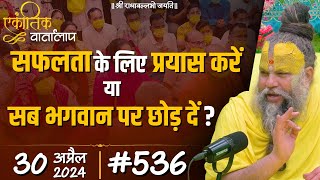 3:06Source for this answerअगर नाम जप की इतनी महिमा है तो क्या जो पाठ, आरती करते हैं उसके जगह नाम जप ही करें ?From 3:06 · 6 min
Frequently asked questions
Is Radha naam better than Ram or Krishna naam?
Ekantik Vartalap does not set one Name against another. Maharaj Ji speaks of Hari, Ram, Krishna and Radha together and says to chant whichever Name is dear to you. If you have received a Name or mantra from your guru, keep to it faithfully.
Do I need a mala, or a fixed count, for Radha naam jap?
A mala or counter can help you stay regular, but Maharaj Ji reminds that God is pleased by remembrance, not by numbers. Whether the mala is in your hand or not, if 'Radha Radha' is running inside, God knows how much you are chanting and for whom.
Can I chant Radha naam while doing housework or office work?
Yes, this is exactly what is encouraged. Keep your regular puja and path, and add the Name to the rest of the day — while cooking, cleaning, serving family or working. Service done with remembrance is itself worship.
What if I chant for my own wishes, not out of pure love?
Begin anyway. The teaching is that the Name brings good in every direction, whether chanted with feeling or without. Maharaj Ji adds that if no desire remains, the Name gives love and understanding itself — so let the wishes be, and let the chanting slowly purify them.
Have a question of your own?
Ask Saarthi in Hindi, English or Hinglish and get an answer grounded in the satsangs, with sources.
This article was written with the help of AI (Claude) from the satsang sources linked above, which are auto-transcribed — please listen to the original for exact words. Saarthi is independent and not affiliated with or endorsed by Shri Premanand Ji Maharaj, his ashram or the Bhajan Marg channel. Not a substitute for medical, legal or mental-health advice.
Keep reading
Naam-jap & bhakti
What Does Surrendering to God Really Mean?
Sharanagati is not giving up or saying a line in prayer. Here is what Ekantik Vartalap teaches about true surrender — in speech, body, mind and the self.
13 October 2026 · 4 min read
Naam-jap & bhakti
How to Focus the Mind During Naam Jap: Simple, Honest Guidance
Why the mind runs away the moment you sit for naam jap, why that is not failure, and the practical steps Ekantik Vartalap gives to bring it back to the Name.
12 October 2026 · 5 min read
Naam-jap & bhakti
How to Start Bhakti as a Beginner: Simple First Steps
New to devotion and unsure where to begin? The simple first steps Ekantik Vartalap gives — naam jap, clean living, serving family — and why fear or need is no barrier.
12 October 2026 · 5 min read