What Does Surrendering to God Really Mean?
· 4 min readहिंदी में पढ़ें

The short answer
In Ekantik Vartalap, Premanand Ji Maharaj explains that surrender (sharanagati) means feeling 'I belong to God, and all I have is His' — not doing puja while still asking Him to fulfil our wishes. It grows in stages: first in speech ('I am in Your refuge'), then in conduct that avoids what displeases God, then in a mind given to His remembrance, and finally the 'I' itself. Its sign is that even unfavourable events begin to feel like His kind arrangement.
Many of us pray, "Lord, I surrender to You," and mean it. Then a result goes against us, and the same heart says, "Why did You let this happen?" We start wondering whether our surrender was ever real, or whether we even know what the word means.
If you have felt this, you are in good company. Surrender — sharanagati — is one of the most asked-about subjects in Ekantik Vartalap, and the answers there are both gentle and very practical. It is not a single dramatic moment. It is a way of belonging to God that grows, step by step, in speech, action, thought and finally in the "I" itself.
What is sharanagati, in simple words?
When asked whether the heart of surrender is devotion or self-offering, Maharaj Ji answers clearly: the main feeling is samarpan, self-offering 22:07. He points out that many people do the outward signs of bhakti — seva, aarti, puja, scripture reading, charity — but not with the feeling "I belong to God." The prayer underneath is still, "Let my work get done, let this happen, let that happen" 22:07.
Surrender is a different inner stance: "I am the Lord's, and everything I have is His." When that feeling settles, he explains, devotion truly awakens; without it, a person may do all the rituals and still be inwardly rooted in money, habits or reputation rather than in God 22:07.
He adds that this self-offering (atma-nivedan) is the ninth step of the nine-fold path of devotion — hearing about God, singing His glories, remembering Him, serving, worship, bowing, servanthood and friendship lead up to it 22:0716:56.
How do I surrender to God completely?
In Ekantik Vartalap, Maharaj Ji describes surrender as happening on four levels 4:59:
- Speech. It begins with words: "Hari, I am in Your refuge." That is a real start 4:59. Surrendered speech also means taking care never to speak ill of anyone 4:59.
- Body and conduct. Do your rightful duties and offer them to God. He uses a traditional principle: accept what is favourable to God and give up what is against Him 4:59.
- Mind. The mind that used to plan pleasures is now given to God's remembrance and naam-jap 4:59.
- The self. When speech, body and mind are offered, the "I" that was attached to them is offered too 4:59.
The Gita closes with this very invitation: set aside every other support and take refuge in Me; I will free you, do not grieve (Gita 18.66).
Why do I still feel upset when things go wrong?
This question came from a seeker who kept saying "Your will be done," yet felt low whenever a result turned out the other way. Maharaj Ji's answer is honest: there is still some gap in the surrender 8:45. Surrender becomes complete, he explains, when the mind is truly at ease with God's arrangement — then even an unfavourable situation feels like grace 8:45.
He gives a touching example. When a child has a painful, infected boil, the mother herself pays the doctor and holds the child's hand during the operation, because she knows healing lies on the other side. In the same way, he says, a hard situation may be clearing away something that would have caused greater suffering — we just cannot see it yet 8:45. A restless heart, he observes, leans on things, people and circumstances; a heart purified by bhajan leans on God 8:45.
That is why his advice here is not "try harder to feel fine." It is: chant the Name a lot. As the heart becomes cleaner, surrender ripens on its own 8:45. The Gita gives the same assurance: to those devoted to Him with an undivided heart, God brings what they lack and protects what they have (Gita 9.22).
Is surrender the easiest way to please God?
Asked for the simplest way to please God — temple, satsang or fasting — Maharaj Ji names surrender 16:56. What could we offer the One who feeds the whole world? Even what we offer in a ritual already came from Him 16:56. So the best offering is the heart that says, "Nath, I am not worthy of You, but whatever I am, I am Yours" 16:56.
He also notes that, by God's own promise, even a person weighed down by grave sins is accepted when they come into His refuge 16:56. Surrender is not a reward for the perfect. It is an open door for anyone willing to turn around.
A daily practice to grow in surrender
- Morning offering. On waking, say once from the heart: "I am Yours, and today is Yours" 4:5916:56.
- Offer the work. Before your job, study or housework, quietly offer it to God — and avoid anything you know is against Him 4:59.
- Guard your speech. For one week, make a firm rule not to speak ill of anyone 4:59.
- Give the mind a home. Each time you notice worry or idle planning, return to naam-jap 4:598:45.
- When something goes wrong, pause and say, "This too is in Your hands." You may still feel sad; keep chanting and let the feeling soften with time 8:45.
If you are struggling because prayers seem unanswered, read why God doesn't seem to listen. And if you are just beginning, how to start bhakti as a beginner is a gentle place to begin.
Surrender is not giving up. It is coming home. Begin with one honest sentence today — "I am Yours" — and let the rest grow from there.
From the Bhagavad Gita
Bhagavad Gita 18.66
सर्वधर्मान्परित्यज्य मामेकं शरणं व्रज ।अहं त्वा सर्वपापेभ्यो मोक्षयिष्यामि मा शुचः ॥
Set aside all other duties and take refuge in Me alone. I will free you from all sins — do not grieve.
Full meaning of Gita 18.66 →Bhagavad Gita 9.22
अनन्याश्चिन्तयन्तो मां ये जनाः पर्युपासते ।तेषां नित्याभियुक्तानां योगक्षेमं वहाम्यहम् ॥
To those who worship Me with undivided devotion, always united with Me, I bring what they lack and preserve what they have.
Full meaning of Gita 9.22 →Hear it from the source
Ekantik Vartalap clips this article draws on, starting at the relevant moment.
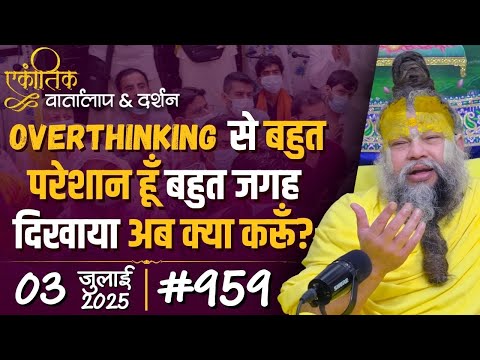
 22:07Source for this answerशरणागति में मुख्य भाव भक्ति है या समर्पण?From 22:07 · 2 min
 4:59Source for this answerकैसे जाने की हम भगवान की शरण में हैं ?From 4:59 · 4 min
 8:45Source for this answerमनोकामना पूर्ण न होने पर भगवान से विमुख हो जाते हैं, दूरदर्शिता कैसे आएगी?From 8:45 · 3 min
 16:56Source for this answerभगवान को प्रसन्न करने का सबसे आसान रास्ता क्या है?From 16:56 · 2 min
Frequently asked questions
Does surrender mean I stop working and leave everything to God?
No. In Ekantik Vartalap, surrender of the body means doing your rightful duties and offering them to God, while avoiding conduct that goes against Him. You still work, study and care for family — the difference is that you do it as His servant, not for your ego alone.
I say 'Thy will be done', but I feel upset when things go wrong. Is my surrender fake?
It is not fake — it is incomplete, and that is normal. Maharaj Ji explains that surrender becomes full when the mind truly agrees with God's arrangement. Until then, keep chanting the Name; as the heart becomes purer, the sadness over results slowly loosens.
Am I worthy of surrendering? I have made many mistakes.
Surrender does not ask for worthiness. The teaching is to say honestly, 'Nath, I am not worthy, but whatever I am, I am Yours.' Maharaj Ji notes that God accepts even a great sinner who comes into His refuge. What matters is turning to Him now and avoiding wrong conduct from here on.
How do I know if I am really in God's refuge?
Signs mentioned in Ekantik Vartalap include becoming free of worry, grief and fear, doubts settling, and remembrance continuing while sitting, walking and eating. Just as you feel satisfied after a meal, you begin to feel 'I am His.' The way there is plenty of naam-jap, regular satsang and care to avoid wrongdoing.
Have a question of your own?
Ask Saarthi in Hindi, English or Hinglish and get an answer grounded in the satsangs, with sources.
This article was written with the help of AI (Claude) from the satsang sources linked above, which are auto-transcribed — please listen to the original for exact words. Saarthi is independent and not affiliated with or endorsed by Shri Premanand Ji Maharaj, his ashram or the Bhajan Marg channel. Not a substitute for medical, legal or mental-health advice.
Keep reading
Naam-jap & bhakti
How to Focus the Mind During Naam Jap: Simple, Honest Guidance
Why the mind runs away the moment you sit for naam jap, why that is not failure, and the practical steps Ekantik Vartalap gives to bring it back to the Name.
12 October 2026 · 5 min read
Naam-jap & bhakti
How to Start Bhakti as a Beginner: Simple First Steps
New to devotion and unsure where to begin? The simple first steps Ekantik Vartalap gives — naam jap, clean living, serving family — and why fear or need is no barrier.
12 October 2026 · 5 min read
Naam-jap & bhakti
The Power of Chanting Radha Naam: What Ekantik Vartalap Teaches
Why the Name is called the one sure remedy for this age, why Radha naam works even without feeling, and how to weave it into daily life without dropping your puja.
12 October 2026 · 5 min read